

Jason Stanley
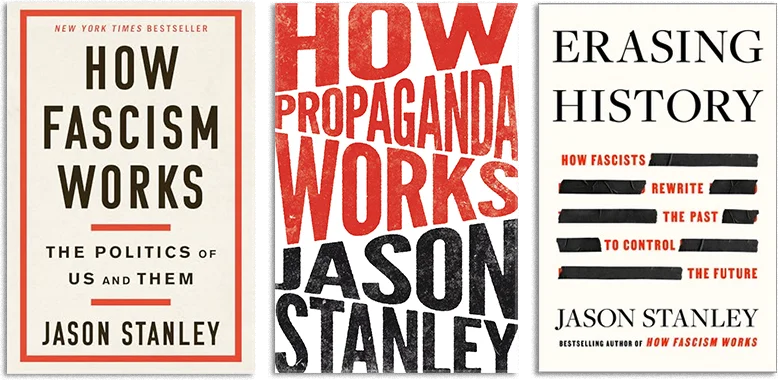
Jason Stanley the wrote bestseller, How Fascism Works.
The descendant of Holocaust survivors, Jason’s breakout book, How Fascism Works, defined the ten pillars of fascist politics.
Jason is a descendant of Holocaust survivors – his uncle served several years in Auschwitz, his mother was raised in a Siberian labor camp, and his father experienced the madness of Kristallnacht. The impact of his family’s experiences led him to dedicate much of his work to studying the ideology and structure around injustice and how it is enabled and concealed.
Formerly a Professor of Philosophy at Yale before leaving the US in 2024, Jason Stanley is now the Bissell-Heyd Chair in the Munk School of Global Affairs & Public Policy at the University of Toronto, where he teaches American Studies.
In How Fascism Works: The Politics of Us and Them, Jason identifies the ten pillars of fascist politics, and charts their horrifying rise and deep history. By uncovering disturbing patterns that are as prevalent today as ever, he reveals that the stuff of politics—charged by rhetoric and myth—can quickly become policy and reality. How Fascism Works is a New York Times Book Review Editor’s Choice, and Claudia Rankine says of the book, “No single book is as relevant to the present moment.”
Jason’s most recent book, Erasing History: How Fascists Rewrite the Past to Control the Future, investigates authoritarian attacks on education worldwide. Khalil Gibran Muhammed said of Erasing History: “I’ve never read a book that is as timely, urgent and essential as this one. A battle plan for keeping this nation from falling into fascism.”
Jason has also authored five other books. His first book was Knowledge and Practical Interests, the winner of the 2007 American Philosophical Association book prize. His second book, Language in Context, is a collection of his papers in semantics on the topic of linguistic communication and context. His third book, Know How, was published in 2011. His fourth book, How Propaganda Works, was the winner of the 2016 PROSE award for philosophy. More recently, he co-authored The Politics of Language with David Beaver, offering a radical new approach to the theory of meaning.
“Jason Stanley is one of this generation’s most insightful and profound thinkers. By weaving together philosophy, history, and contemporary events, he offers a vital perspective on truth, power, and democracy. Few voices today are as equipped as his to help us navigate these challenges.”
—Association of Art Museum Directors

Azura Says
“Jason gives me the tools to reason myself out of despair. To understand authoritarian politics–all its smoke and mirrors and tricks of language and division–takes power away from it.”
Expertise
- Expert on authoritarianism, disinformation, social movements, and propaganda
- Linguistic and political philosopher
- Advocate for democracy, education, and civic engagement
Video Highlight
The 10 Tactics of Fascism, —Big Think